
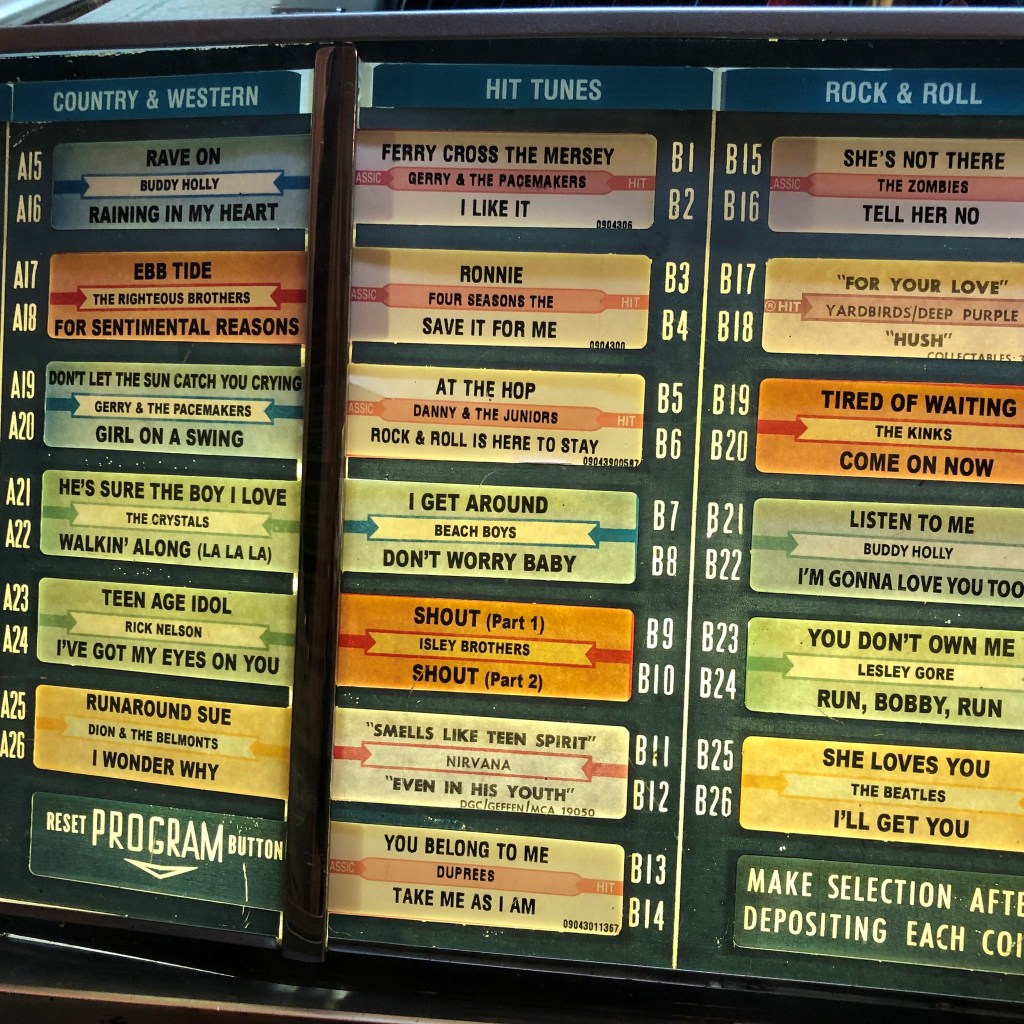
“In a lifetime of living in this body, I have known no more powerful a homecoming than music — nothing roots us more firmly into the house of being, nothing levitates us more buoyantly to that transcendent place beyond marrow and mind.”
~ Maria Popova
I remember being at our grandmother’s house, banished outside during her time tutoring students in music. The grand piano — off limits to us kids — was the centerpiece of the front room of her Victorian house at the top of a small hill in Weatherford, a small Texas town. From there, my grandmother shaped, or attempted to shape, small-town kids of various ages to appreciate something besides country music.
We boys played cowboys and Indians or touch football on the lawn to the accompaniment of the young voices in training. Her shining pupil was our older cousin, perfecting her voice with exercises where the piano and young voices went, in higher and higher notes: “La, la, la, la, la, la, (skip up a few notes), Laah!” This cousin went on to the local junior college where she starred in college musicals, then briefly on to New York City to try ‘real’ opera.
Outwardly disdainful, I was always somewhat in awe of the singer’s abilities. I enjoyed singing myself, at first all the nursery rhyme songs and games. Also, at our church — where musical instruments were frowned upon — we sang acapella hymns, after being futilely given the key by the preacher’s pitch pipe. Then in grade school we sang in music class, segregated by vocal range. Unfortunately, I was the biggest in the class, but relegated with the girls to the soprano section.
Maria Popova quotes Richard Powers, “The small boy, untainted with concepts, experiences music in its purest form, pouring out of the singers like daybreak, like something of another world, yet saturated with pure translucent presence, in that peculiar way transcendent experiences have of taking us both beyond and deeper into ourselves.”
As I grew older, I began to copy the songs I heard on the radio or records. So, in my own mind, I became adept at Elvis, Kingston Trio and Everly Brothers’ songs and lots of country-western favorites. My mother claimed I had ‘perfect pitch’, but I suspect she was biased.
I never had the digital dexterity to play the piano or other instruments, but have always enjoyed singing. The eight-track tape player in my car got a workout whenever I drove back and forth to college in Oklahoma. Riders of the Purple Sage, Buck Owens, Ernie Ford (had to go way low for his songs), Roy Orbison, Arlo Guthrie, John Denver, Neil Diamond, and even Janis Joplin and Joni Mitchell, among others, got me through college.
I also learned about rock and roll, and became an ardent Jimi Hendrix fan, along with a slew of others. I learned that dance music wasn’t just the square-dancing I had been taught in elementary school or the tight-hug shuffle for the slow dances in high school. My frat house had some great parties on Saturday nights once a month, so I could find a date (sometimes with a fraternity brother’s help), and learn how to really ‘cut a rug!’
My musical tastes have broadened and expanded as I have grown older. Few people can match (at least in my mind) my renditions of songs from The Sound of Music, Paint Your Wagon, Camelot or even Cabaret. (Of course, you’d have to hide out in the back of my car on a road trip to get the full experience.)
While my grandmother might shudder today at my ‘perfect pitch’, there’s probably one thing upon which we would both have agreed with Friedrich Nietzsche:
“Without music, life would be a mistake.”
Additional information:
Maria Popova, “Music and the Body: Richard Powers on the Power of Song“, The Marginalian, 11/1/23
 Writes of Nature