
“It’s likely that the first use of compost — or at least manure — took place not long after the start of cultivation … After all, a people who lived close to nature would soon have noticed the grass grew greener where an animal had deposited its poo.”
~ Compost Magazine
I’ve been composting for many years. Originally, it was just grass clippings, garden detritus and fall leaves, but then I moved on to food scraps. Even though I took the pile apart every year in the spring, over time the compost pile grew larger as I collected more and more waste in it. A few years ago, we abandoned the large flat garden that ran across the back of the lot for four wooden raised garden beds, that were easier on my back. At the same time, we also moved the compost pile nearer to the beds.
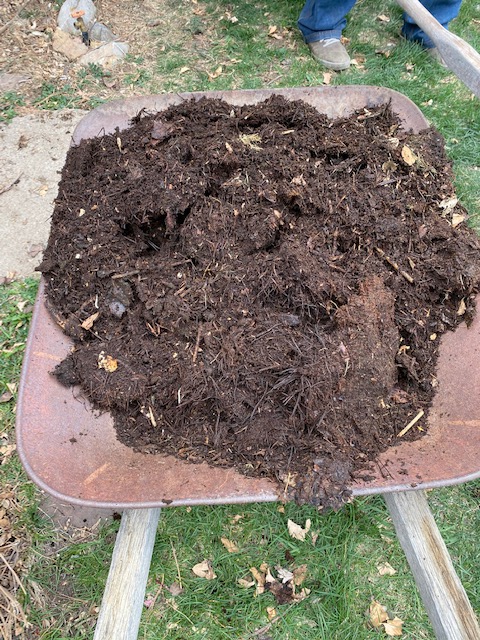
It is so rewarding when I break the pile open to reveal the rich, black material that has alchemized over the winter from the leaves, grass, kitchen scraps and whatever else has gotten into the pile. I spread the loamy compost across the vegetable beds and gently turn it in when I’m ready to plant, and there is even enough excess to top dress some of the flower beds around the house. I used to spread the compost across the large garden and till it into the soil — until I realized I was just furthering the reach of the bindweed. While the soil in our yard is basically outwash from the mountains, it never was in particularly bad shape; however, I could tell over time that the compost made the soil less clayey and turned it much blacker and more easily worked. We imported fill dirt suitable for planting when we constructed the garden beds, and the added compost has helped to keep it black and rich, and allows the worms to thrive.
Metaphorically, I’m plowing old fields. According to The Compost Post, “Research in Scotland is starting to provide some early evidence of this. Digs in Scotland have found that use of domestic waste as compost started as far back as the Neolithic period… The practise of fertilisation continued through multiple civilisations … The Romans, Greek and Egyptians fertilised fields in several ways … They would spread manure directly on the fields, collect and compost waste on dung hills and use manure and urine soaked straw.”
“The importance of compost and fertiliser lead to a litany of references in both the Talmud and the Bible … The Aztecs built a system of human latrines throughout their city. The faeces from these was collected and used as compost, along with guano.”
“The Aztecs weren’t the only civilisation to value human waste … Centuries before, in Ancient Athens, excrement was collected by the sewage system … The sewage stored in a reservoir and transported to the Cephisus river valley where it was used as a fertiliser… Night soil was also hugely important in Asia. In Japan, for example, compost collectors would pay to take away night soil … Night soil has also been collected in China for centuries, a practice which they called ‘emptying nocturnal fragrance’”.
Science reporter Rodrigo Pérez Ortega discusses the continuing practices of Amazonian indigenous peoples, “New research shows modern Kuikuro people make fertile soils by piling up refuse in middens at the edge of their backyards and along trails leading out of their village … Mysterious patches of fertile black soil pepper the verdant Amazon rainforest. They sit in stark contrast with the reddish, eroded soil that dominates the basin. Researchers have long thought this Amazonian dark earth — or terra preta — was created by pre-Hispanic Indigenous civilizations, which have inhabited the region for millennia.”
I admit, I’m not as diligent as those older peoples. We don’t collect our ‘sewage’ for use in the compost, regardless of its “nocturnal fragrance.” However, I believe the metro area sewage treatment people do retrieve the treatment plant waste sludge for use on farmland. And recently, the city-contracted garbage company has added bins for compostable materials to the array of trash and recycling bins that they supply.
I admit that I am loathe to use those bins, since I’d rather make my own ‘terra preta’ for my garden.
Additional Information:
Compost Magazine, Compost History: The Fascinating Story of an Ancient Science, Undated
Rodrigo Pérez Ortega, Ancient Amazonians Created ‘Dark Earth’ on purpose, September20, 2023, Science
Steve Tarlton, Rotten, Writes of Nature, May 25, 2023
Steve Tarlton, The Compost Post, March 2, 2023
 Writes of Nature