
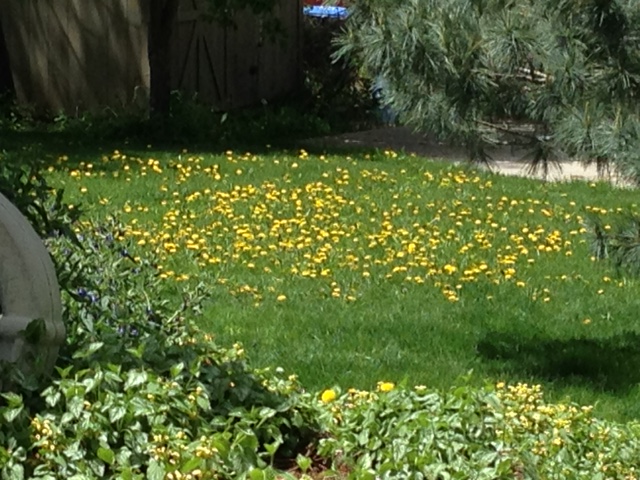
Our yard tends to be shabbier than most of our neighbors’, even now that we use a regular mowing service. Dandelions proliferate, and crabgrass competes with the clover. However, for the most part, it seems to be healthy, if not too closely managed.
The crabapple and sand cherry trees, and the lilacs, butterfly and bridal wreath shrubs blossom at their appointed times. Some strange plants with blue flowers follow the fence lines and avoid the lawn. We have a mixture of old and less old, tall and less tall trees across the lot, intermixed with the various flowering and non-flowering shrubs. The Limber Pine tree creates a carpet of needles beneath. The ancient trumpet vine has grown the height of the house, splaying across the second level and onto the roof. We tend the flower beds and garden boxes, and generally let the rest of the yard express itself.
We’ve toyed with the idea of letting it all go, except for scattering some wildflower seeds throughout. Maybe we just long for some wildness.
Author Emma Marris notes, “Many people value wildness. But which kind of wildness do they mean? Do they mean that they value things that are not influenced by humans? Do they just hate anything that humans have touched? I don’t think love of the wild is usually so simple-mindedly misanthropic. I think for most people, loving the wild means respecting the well-being and independence of other species and seeking to be humble, to step back from being in control. Defining wildness as individual autonomy captures those ethical features.”
We do have quite a few wild creatures about, too. Lots of birds and squirrels, some mice under the bird feeder, some bunnies living under the shed, occasional visiting raccoons, and recently, a rare black bear cub. In the winter we may see a deer or elk pass through, and last summer a moose checked out our front porch. (Its hard not to play up the ‘moose and squirrel’ idea.)
We enjoy all the critters and the wildness makes me feel a part of a greater whole. Our domestic critters interact with the wild ones — we feed the birds, the dog chases the squirrels, the cats catch some mice and maybe a bird, and the next-door neighbor’s dog bit the bear on the butt before chasing it off. (So far, nobody has messed with the moose, deer or elk.)
Marris explains, “A wild place is a place that humans have not shaped … But if we define wildness as ‘uninfluenced by humans,’ then there is probably no complete wildness left … all animals and all places are now influenced by humanity, at least to some degree.“
I also believe the opposite to be true.
Marris continues, “We are surrounded by other creatures with their own agendas going about their sometimes-mysterious business. For me, this simple revelation changes the texture of the city. I see it now as an ecosystem of wild creatures that just happens to also feature lots of concrete and glass … Living together is always a compromise, and no autonomy is complete. In human societies we agree to limit our own freedoms to better coexist, and we should make compromises in interspecies relationships, too … There’s a lot about ecology we still don’t understand. We should be humble and let other organisms make their own choices, except in situations where we choose to intervene to protect ourselves or other species.”
Margaret Roach cites an example, “Very old trees may seem dangerously large, prompting calls for removal. But if they create no threat to people or property, and are left to decline in place, they contribute to ecological diversity … It’s one of the costliest actions we take in managing our landscapes — in terms of dollars and environmental damage — and yet we keep cutting down and carting away the remains of trees. Even those that pose no danger to people or property.”
She quotes arborist Basil Camu, “Let it participate and help the ecosystem … ‘when a tree dies, it enters into its second life, with this incredible new community that builds and thrives around it’…His unconventional approach: Let it be.”
Maybe a little wildness in our yards would improve a lot of our lives, and not just the wild things’ that share our world with us.
ADDITIONAL INFORMATION:
Emma Marris, New York Is Wilder Than You Think, The New York Times, March 17, 2024
Margaret Roach, Why One Man Runs a Tree Service That Won’t Cut Down Dead Trees, May 9, 2024, New York Times
 Writes of Nature