
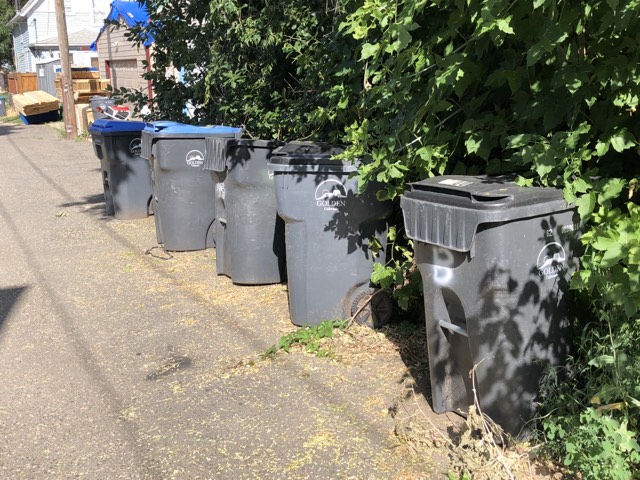
Wheeled, plastic bins line the alley behind our houses. Black lid for trash, blue lid for recycling, and green lid for yard waste. Since we keep a compost pile in the garden, we don’t have a yard waste bin, but there are a few out there. Only collected every second week, the recycling bins are often overstuffed — mostly because some people fail to break down cardboard boxes. That’s also where some of the interesting items end up — the ironing board, the clothes rack, various items that could go to Goodwill if someone would take the trouble to donate them.
In our house, we’re pretty diligent recyclers — paper, metal, wood, glass and plastic — but I remain confused about which plastics should not be placed in the recycling bin. For a long time, I just tossed anything that didn’t fit the trash or compost category into recycling. Then I started to look for the little triangle symbol. Now I understand that I’m supposed to be able to read the number inside the little triangle in order to determine which bin it goes into. Without my glasses, that’s a pretty tall order and a pain …
Technology correspondent Chang Che writes, “Now the environmental agency that oversees recycling efforts in the United States is saying that, after close to five decades in the public eye, the “chasing arrows” logo should be retired from plastics that are difficult to recycle … Manufacturers often pair the iconic logo with a resin identification code, with numbers from 1 to 7 that indicate the type of plastic in the product. ‘Not all resin codes can be recycled currently in the United States,’ EPA’s Jennie Romer wrote. Many plastics, especially those numbered from 3 to 7, ‘are not financially viable to recycle.’”
“John Hocevar, oceans campaign director at Greenpeace U.S.A. said. ’Your average person wants to do the right thing. They look at the stuff that they bought from the store, they see recycling symbols on it and they put it in the recycling bin.’”
“’But most of those items are not being recycled,’ Mr. Hocevar said. The waste overwhelms recycling centers instead, diverting effort away from paper, aluminum and glass items that are easier to recycle … the misuse of the recycling logo in plastic products may be contributing to a growing plastic-waste crisis.”
The EPA wants “to substitute the arrows logo on plastics with solid triangles, a decision that the agency believes could help clear up confusion around labeling. The goal is to relieve recycling facilities of the burden of dealing with plastic items that they cannot process.”
I’m all in favor of making it easier to know what to recycle and what to trash. However, I don’t think the best way to do that is to address the issue at the trash/recycling bin. Rather, let’s deal with it at the point of manufacture. If the item costs more to recycle or can only be trashed, the consumer should be charged more for that it or its packaging.
I’m thinking a “toss tax” on items that can’t be recycled, and maybe an additional fee if it’s possible but expensive. This would shift the expense of recycling from the recycling facilities to the manufacturers, and it would certainly make it easier on the conscience of us consumers who hover over the bins, stressing about which one gets which item. I think of it as “decycling.”
Additional information:
Chang Che, His Recycling Symbol Is Everywhere. The E.P.A. Says It Shouldn’t Be. Aug. 7, 2023, The New York Times
Laura DiMugno, Recycling Symbols Decoded, June 13, 2022, TreeHugger
 Writes of Nature
Adding cost during inflation isn’t going to go well but I do like the idea! I also think switching to only labeling the things that are getting recycled would be beneficial at this point because I don’t see the recycling situation changing soon. But we had so much education pushed on us in the 80s and 90s about recycling, it might die hard!
LikeLike