
“The best time to plant a tree is twenty years ago. The second best time is now.”
~ Unknown
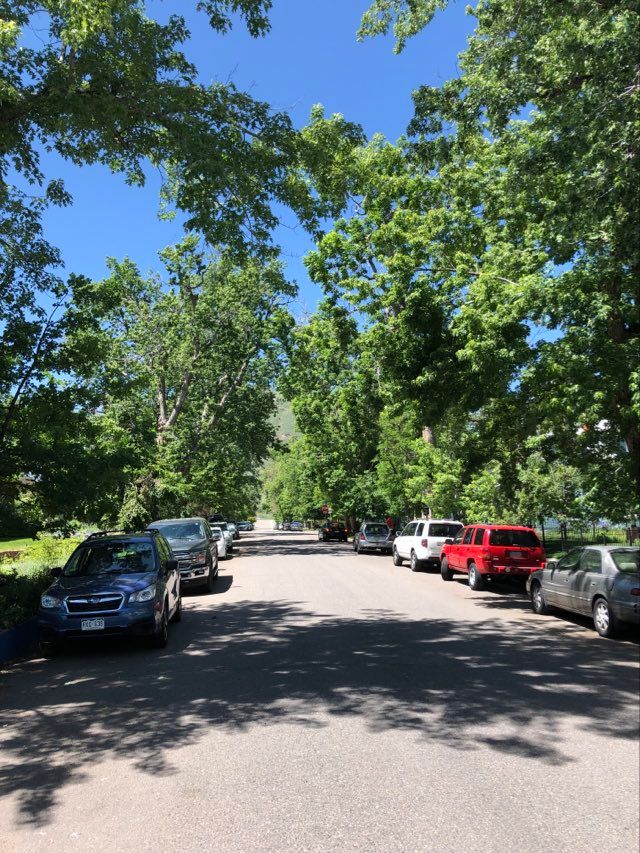
My small town enjoys tree-lined older neighborhoods that are pleasant to walk through and front porches that are nice to sit on. The combination of shade trees and other vegetation keeps the local climate comfortable, even if it gets really hot, like it has done lately. I try to take a clue from the local critters — dogs, cats, squirrels and kids — and stay in the shade if not in the AC-cooled houses. However, according to an article in Nature magazine, “most cities fail to provide citizens with enough shade. Low-income and marginalized communities tend to be worst affected, because they frequently live in the hottest urban areas and lack the resources, such as air conditioning, to cope.”
Much of our downtown features old west-style canopies over the sidewalks, a part of the town’s “Where the West Remains” concept. These provide shade and make shopping in the several blocks of businesses tolerable in the heat and easier walking in the snow. In addition, planter boxes full of blooming plants have been added on the curb line, along with some smaller trees that may take a while to provide much shade, but do look nice now.
Turner, et al write in Nature, “Limiting exposure to the Sun through shade is one of the most efficient and cost-effective ways to reduce heat-related health risks outdoors. Shade is simple to create using trees, buildings, canopies, shade sails, awnings and walls, yet is frequently overlooked in urban planning and climate-change mitigation strategies.”
They continue, “Shade is an intuitive solution to heat: almost 40% of adults in the United States seek shade when outdoors, according to the US National Cancer Institute (https://progressreport.cancer.gov). Shade is effective at cooling because it protects the body from the Sun’s short-wave radiation, which includes ultraviolet and visible light — the main factor that determines human thermal comfort under warm or hot conditions outdoors. It also protects the body from hot surfaces and the heat they release.”
When I worked on the Navajo Reservation in the early 1970’s, I often spent most of my days out in sparsely populated areas with only a few rustic homes, hogans and herds of sheep. There were a few springs scattered around against the mesas, and each was accompanied by massive cottonwood trees. In the summer, the shade and cooling they provided made being out there possible in my government non-AC’ed pickup. Usually I could sit in my truck in the shade, accompanied by a herd of sheep also seeking respite from the sun, have a drink and cool down for a while. Even the sun-hardy Navajo knew better than to stay out in that summer sun, and considered us bilagáana (white guys) to be crazy when we did so.
“According to the American Forests Tree Equity Score — a national indicator of disparities in the distribution of urban trees — the poorest neighborhoods in the United States have 41% less tree canopy than do the wealthiest ones, and people of color typically live in areas that have one-third less shade than do areas where the majority of residents are white … Urban ‘shade deserts’ — places lacking the shade needed to reduce heat burden and protect human health outdoors — are part of the lived experience for low-income communities, and exacerbate heat-health disparities.”
Unfortunately, shade from trees requires some forethought, since it takes years for trees to be big enough to shade much at all.
The Hopi villages just to the north of where I worked mostly consisted of adobe houses with thick walls and small windows that kept the interiors cool in the summer and warm in the winter. Unfortunately, newer reservation housing usually consisted of frame houses or mobile homes, ill-suited for the desert conditions.
Climate change is coming, and we need to begin to prepare for a harsher climate. “To address this challenge, cities must manage and improve the infrastructure that provides shade, just as they do for energy or transport … For centuries, shade was an integral part of urban design. The Romans designed homes with courtyards to provide shade and fountains to provide evaporative cooling. Buildings in hot regions typically incorporated courtyards and overhangs, and in some cities, streets were oriented to block the Sun.”
Additional information:
V. Kelly Turner, Ariane Middel and Jennifer K. Vanos, Shade Is An Essential Solution For Hotter Cities, Nature, 7/26/2023
 Writes of Nature