
Recently, the BBC released a list of the 100 best children’s books ever. Reading the list evoked my childhood and even my later youth. My father read to us frequently, and I became the reader for my younger sister, a role I kept into my teens. My wife and I both read to our son, and it seems that my exposure to many of the “children’s” books on this list came when I was older.
Books were a treasure in my family’s home and continue to be in ours today. I recently dragged out of the closet the stored boxes labeled “Kids Books” and flipped through them, relishing the titles and cover art. Some were very old and worn, predating my own childhood, and presumably handed down from my parents or other family. One was inscribed to my father from an aunt, and others were recent enough that it stirred fond memories of reading to our now thirty-something son.
What is more warming than reading to a child snuggled in your lap? I get sleepy just remembering it.
Part of the allure to me is the joint exploration with a child. A new story is rife with unexpected scenes and characters that are compelling to follow. A familiar story smooths the ruts in your brain and takes you on a familiar journey where the rewards of the road ahead can be eagerly anticipated. You get to relive your own childhood through the child’s experience. It is magical.
I found the BBC list to be a little problematic, in that I segregate books for children from those for young adults, but it combines both. I don’t really see Le Guin, Tolkien, or Pullman as writers for children. Their stories are great, but certainly at a different level than Potter, Lewis, Milne and Sendak.
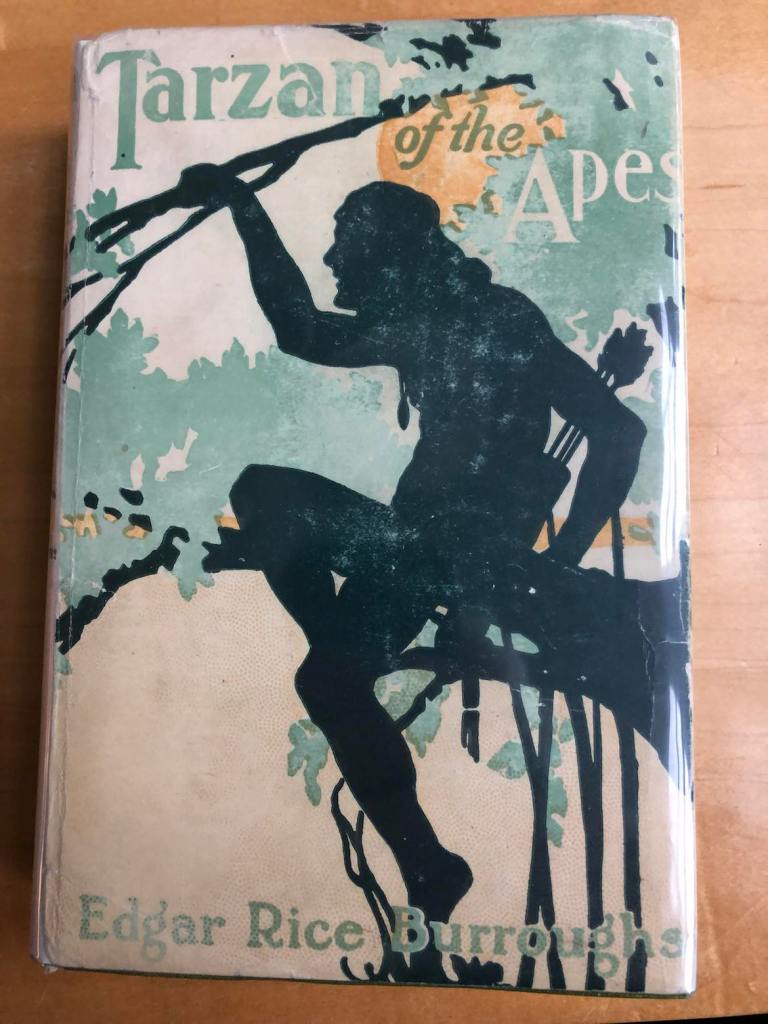
Of course, many of the books’ appeal crosses generations. One summer when I was in college, I reread Lewis Carrol and Milne, and found them totally compelling and enjoyable. I will admit that I am a perennial Edgar Rice Burroughs fan, as was my father, and have collected most of the Tarzan, John Carter and his other series. I also have collections of H. Rider Haggard (Alan Quartermain), Victor Appleton, Jr and Sr (Tom Swift, Jr. and Sr.), and some others. I stay amazed at the wit of writers like Roald Dahl, L. Frank Baum, Kenneth Grahame, and Shel Silverstein who can draw in “kids” of all ages. I did find the absence of The Jungle Books by Rudyard Kipling to be a grievous oversight in the list.
Our current perspective on compelling literature for children can sometimes be assessed by which stories have been converted to the big or little screen, either animated or non-. While I believe that the written word unleashes imagination in a massive way, I don’t discount the effect that visual representation can have on it. That is precisely why we have picture books for kids and most of our cherished childhood books are grandly illustrated. Milne’s stories would be incomplete without Shepard’s representations and Dr. Seuss would have a tepid tale without his zany illustrations.
That’s not to say that watching a cartoon triggers the imagination as well as reading a book, but I don’t discount that as a learning tool. There is also the effect of a shared experience to a story. Being in a room watching with others can reinforce the emotional and intellectual impact of something on a screen. It is also true that the addition of sound, say music, enhances the experience. Tigger’s growly voice or Pooh’s soft lilting “Hmm” certainly completes the picture. I still remember the visual and physical impact of the opening credits of the first Star Wars movie, and I can still sing many of the songs from Mary Poppins and Jungle Book (however poorly). It’s hard to get that from a book.
Additional information:
 Writes of Nature